Monday, 11 April 2016

Waterloo (the chess card game)

Life is not a matter of holding good cards, but of playing a poor hand well.
Robert Louis Stevenson

Waterloo (the chess card game)

Kosintsev I.G.
kosintsev.i.g@gmail.com
(27.04.2016)

Dear friends! I hasten to please you. Now you can play the new color card version Waterloo without a board in a 3D format.
The using of an excessive playing cards deck dedicated to chess instead a board with chess pieces (as at Solitaire) is a lucky idea for chess variants, because this revolutionary innovation allows to change free the sizes of the already virtual board and the set of the using cards (a hand) in agree with own taste or by chance as at Fisher chess variant and so do the chess more popular and competitive contra other games.
This 8x8x2 chess card game has wide strategic and tactical possibilities but at the same time is using an extended set of the chess pieces with the traditional style of movement well known to all chess players. Cards are arranged hierarchically and harmonically at the initial positionon on two complementary sides as follows.


The complete set of the chess Waterloo have 80 cards: 40 white (20 blue and 20 red) and 40 black (20 grin and 20 yellow).


The reduced set of the chess Waterloo have 40 cards: 20 white (blue) and 20 black (yellow).

Internet resources:
1. Catherine Perry Hargrave
A History of Playing Cards and a Bibliography of Cards and Gaming.
2. Three-dimensional chess.
http://en.wikipedia.org/wiki/Three-dimensional_chess
3. Alice Chess
https://en.wikipedia.org/wiki/Alice_chess

Sunday, 13 March 2016

Mirage

"Illusions," explained Alec, "are like mirages," and, realizing that this didn't help much, he continued: "And mirages are things that aren't really there that you can see very clearly."
Norton Juster

Mirage (the chess variant)

Kosintsev I.G.
kosintsev.i.g@gmail.com
(11.04.2016)

Dear friends! I hasten to please you. Now you can play the chess set Waterloo in a 3D format on two conventional chessboards.
This 8x8x2-squares chess variant has wide strategic and tactical possibilities but at the same time is using an extended set of the chess pieces with the traditional style of movement well known to all chess players. Pieces are arranged hierarchically and harmonically at the initial positionon on two complementary boards as follows.


The complete set of the chess Waterloo have 80 pieces: 40 white and 40 black.

The basic initial white pieces (Humans):
1. (P) Pawn: a21, b21, c21, d21, e21, f21, g21, h21 (8 pieces).
2. (N) Knight: a22, b22, g22, h22 (4 pieces).
3. (G) Guard: a12, b12, g12, h12 (4 pieces).
4. (B) Bishop: c12, f12 (2 pieces).
5. (C) Cardinal: d12, e12 (2 pieces).
6. (R) Rook: a11, h11 (2 pieces).
7. (M) Marshal: b11, g11 (2 pieces).
8. (A) Adviser: c11, f11 (2 pieces).
9. (Q) Queen: e11 (1 piece).
10.(K) King: d11 (1 piece).

The additional reserved white pieces (Aliens):
1. (S) Spy: c22, d22, e22, f22 (4 pieces).
2. (J) Joker: c02, f02 (2 pieces).
3. (F) Fantom: d02, e02 (2 pieces).
4. (D) Demon: c01, f01 (2 pieces).
5. (W) Wiseman: d01,e01 (2 pieces).

The basic initial black pieces (Humans):
1. (P) Pawn: a71, b71, c71, d71, e71, f71, g71, h71 (8 pieces).
2. (N) Knight: a72, b72, g72, h72 (4 pieces).
3. (G) Guard: a82, b82, g82, h82 (4 pieces).
4. (B) Bishop: c82, f82 (2 pieces).
5. (C) Cardinal: d82, e82 (2 pieces).
6. (R) Rook: a81, 81 (2 pieces).
7. (M) Marshal: b81, g81 (2 pieces).
8. (A) Adviser: c81, f81 (2 pieces).
9. (Q) Queen: d81 (1 piece).
10.(K) King: e81 (1 piece).

The additional reserved black pieces (Aliens):
1. (S) Spy: c72, d72, e72, f72 (4 pieces).
2. (J) Joker: c92, f92 (2 pieces).
3. (F) Fantom: d92, e92 (2 pieces).
4. (D) Demon: c91, f91 (2 pieces).
5. (W) Wiseman: d91,e91 (2 pieces).

Sunday, 24 January 2016

Waterloo 百田棋 (4th edition)

It is here that the battle of Waterloo was won!
Duke of Wellington

Waterloo 百田棋 (the chess variant)
(4th edition)

Kosintsev I.G.
kosintsev.i.g@gmail.com
(13.03.2016)

Hello chess players! I continue to go with the chess evolution and had gone via Avant-garde Grand chess to the more perfect chess variant titled “Waterloo”.
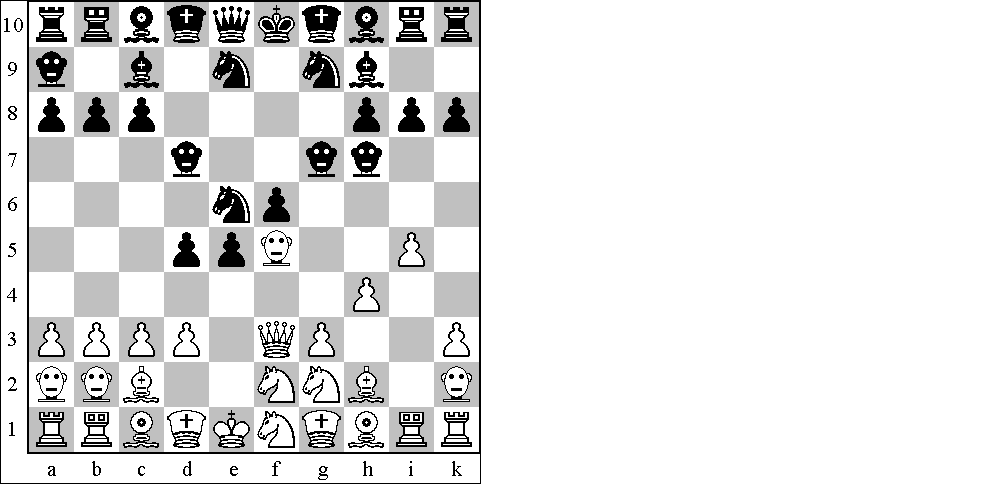
This 100-squares chess variant has wide strategic and tactical possibilities but at the same time is using an extended set of the chess pieces with the traditional style of movement well known to all chess players. Pieces are arranged hierarchically and harmonically at the initial position.
The initial (in agree with etiquette centre-symmetrical) position at the game Waterloo with the 10x10 board is follows.


The complete set of the chess Waterloo have 80 pieces: 40 white and 40 black.

The basic initial white pieces (Humans):
1. (P) Pawn: a3, b3, d3, e3, f3, g3, i3, k3 (8 pieces).
2. (N) Knight: d2, e2, f2, g2 (4 pieces).
3. (G) Guard: a2, b2, k2, i2 (4 pieces).
4. (B) Bishop: c2, h2 (2 pieces).
5. (C) Cardinal: c1, h1 (2 pieces).
6. (R) Rook: a1, k1 (2 pieces).
7. (M) Marshal: b1, i1 (2 pieces).
8. (A) Adviser: d1, g1 (2 pieces).
9. (Q) Queen: f1 (1 piece).
10.(K) King: e1 (1 piece).

The additional reserved white pieces (Aliens):
1. (S) Spy: c3, h3, r5, s5 (4 pieces).
2. (J) Joker: r4, s4 (2 pieces).
3. (F) Fantom: r3, s3 (2 pieces).
4. (D) Demon: r2, s2 (2 pieces).
5. (W) Wiseman: r1,s1 (2 pieces).

The basic initial black pieces (Humans):
1. (P) Pawn: a8, b8, d8, e8, f8, g8, i8, k8 (8 pieces).
2. (N) Knight: d9, e9, f9, g9 (4 pieces).
3. (G) Guard: a9, b9, k9, i9 (4 pieces).
4. (B) Bishop: c9, h9 (2 pieces).
5. (C) Cardinal: c10, h10 (2 pieces).
6. (R) Rook: a10, k10 (2 pieces).
7. (M) Marshal: b10, i10 (2 pieces).
8. (A) Adviser: d10, g10 (2 pieces).
9. (Q) Queen: f10 (1 piece).
10.(K) King: e10 (1 piece).

The additional reserved black pieces (Aliens):
1. (S) Spy: c8, h8, r6, s6 (4 pieces).
2. (J) Joker: r7, s7 (2 pieces).
3. (F) Fantom: r8, s8 (2 pieces).
4. (D) Demon: r9, s9 (2 pieces).
5. (W) Wiseman: r10, s10 (2 pieces).

Rules:
1. The orthogonal mode of the movement O or O(n), where n is the number of the path cells.


2. The diagonal mode of the movement D or D(n), where n is the number of the path cells.


3. The jumping mode JO or JD means that a piece can jump with own move over exactly one other piece.
4. The neighbor mode of the movement N or N(n), where n=1,2,3 over the neighbor occupied or unoccupied squares (Jump).


1. (P) The pawn moves without the capture by O(1) mode or with the capture by D(1) mode.
Pawn may advance in its first ahead move, without capturing, by O(2) mode.
The pawn may standard capture «en passant».
The pawn that reaches the eighth promotion row can optionally promote for the spy. The pawn that reaches the ninth promotion row can optionally promote for the joker.
The pawn that reaches the last promotion row can optionally promote for the fantom, demon or wiseman.
2. (N) The knight moves by N(3) mode.
3. (G) The guard (pasha or mastodon) jumps by N(1) or N(2) modes.
The guard can move to the square occupied by own knight with the merge both pieces to form one joker. The inverse transformation is banned.
The guard that reaches the ninth promotion row can optionally promote for the joker.
The guard that reaches the last promotion row can optionally promote for the wiseman.
4. (B) The bishop moves by D mode.
The bishop that reaches the last promotion row can optionally promote for the fantom.
5. (C) The cardinal combines the powers of the bishop and knight.
6. (L) The rook moves by O mode.
The rook that reaches the last promotion row can optionally promote for the demon.
7. (M) The marshal combines the powers of the rook and knight.
8. (A) The adviser moves by O or D modes.
The adviser that reaches the last promotion row can optionally promote for the wiseman.
9. (Q) The queen (Amazonka) combines the powers of the adviser and knight.
10. (K) The king moves by N mode during the game, provided that he hasn't been checked before he makes his move. It loses the right to make N(2) and N(3) moves after the check and moves only by N(1) mode.
Castling doesn't exist (compare with Chaturanga [3]).
11. (S) The spy moves by N(1) mode.
12. (J) The joker moves by N mode.
13. (F) The fantom moves by JD mode or without the capture by O(1) mode.
14. (D) The demon moves by JO mode.
15. (W) The wiseman moves by JO or JD modes.
Other rules of this game are identical with rules of classical chess [1].

Internet resources:
1. Chess.
http://en.wikipedia.org/wiki/Chess
2. Chess.com.
http://www.chess.com/
3. Chaturanga.
http://www.chessvariants.org/historic.dir/chaturanga.html
4. Omega Chess.
http://susanpolgar.blogspot.com/2007/08/omega-chess.html
5. Wikipedia, the free encyclopedia. Grand chess.
1 http://en.wikipedia.org/wiki/Grand_chess
6. Archchess.
http://www.chessvariants.com/historic.dir/arch.html
7. Pacific Chess.
http://www.chessvariants.com/large.dir/pacific.html
8. Mideast Chess.
http://www.chessvariants.com/large.dir/mideast.html
9. Mastodon Chess (10x10).
http://hem.passagen.se/melki9/mastodon.htm
10. Modern Grand Chess.
http://chess-checkers-go.blogspot.com/2010/02/modern-chess.html
11. Avant-garde Grand Chess.
http://chess-checkers-go.blogspot.com/2013/02/avant-garde-grand-chess.html
12. Tarot. https://en.wikipedia.org/wiki/Tarot

Saturday, 26 December 2015

Waterloo 百田棋 (3rd edition)

It is here that the battle of Waterloo was won!
Duke of Wellington

Waterloo 百田棋 (the chess variant)
(3rd edition)

Kosintsev I.G.
kosintsev.i.g@gmail.com
(26.12.2015)

Hello chess players! I continue to go with the chess evolution and had gone via Avant-garde Grand chess to the more perfect chess variant titled “Waterloo”.
This 100-squares chess variant has wide strategic and tactical possibilities but at the same time is using an extended set of the chess pieces with the traditional style of movement well known to all chess players. Pieces are arranged hierarchically and harmonically at the initial position.
The initial (in agree with etiquette centre-symmetrical) position at the game Waterloo with the 10x10 board is follows.

White:

1. (P) Pawn: a3, b3, c3, d3, e3, f3, g3, h3, i3, k3.
2. (N) Knight: d2, e2, f2, g2.
3. (G) Guard: a2, b2, k2, 8i2.
4. (B) Bishop: c2, h2.
5. (C) Cardinal: c1, h1.
6. (R) Rook: a1, k1.
7. (M) Marshal: b1, i1.
8. (A) Adviser: d1, g1.
9. (Q) Queen: f1.
10.(K) King: e1.


Black:

1. (P) Pawn: a8, b8, c8, d8, e8, f8, g8, h8, i8, k8.
2. (N) Knight: d9, e9, f9, g9.
3. (G) Guard: a9, b9, k9, i9.
4. (B) Bishop: c9, h9.
5. (C) Cardinal: c10, h10.
6. (R) Rook: a10, k10.
7. (M) Marshal: b10, i10.
8. (A) Adviser: d10, g10.
9. (Q) Queen: f10.
10.(K) King: e10.


The hieroglyphic japanesque design is more simple and convenient for game.


Rules:
1. The orthogonal mode of the movement O or O(n), where n is the number of the path cells.


2. The diagonal mode of the movement D or D(n), where n is the number of the path cells.


3. The neighbor mode of the movement N or N(n), where n=1,2,3 over the neighbor occupied or unoccupied squares (Jump).


1. (P) The pawn moves without the capture by O(1) mode or with the capture by D(1) mode.
Pawn may advance in its first ahead move, without capturing, by O(2) mode.
The pawn may standard capture «en passant».
The pawn that reaches the eighth promotion row can (at the player's disire) promote or not promote for spy moving by N(1) mode. The pawn that reaches the ninth and last promotion row can (at the player's disire) promote or not promote for the piece (except King) corresponding to this row at the initial position.
2. (N) The knight moves by N(3) mode.
3. (G) The guard (pasha or mastodon) jumps by N(1) or N(2) modes.
4. (B) The bishop moves by D mode.
5. (C) The cardinal combines the powers of the bishop and knight.
6. (L) The rook moves by O mode.
7. (M) The marshal combines the powers of the rook and knight.
8. (A) The adviser moves by O or D modes.
9. (Q) The queen (Amazonka) combines the powers of the adviser and knight.
10. (K) The king moves by N mode during the game, provided that he hasn't been checked before he makes his move. It loses the right to make N(2) and N(3) moves after the check and moves only by N(1) mode.
Castling doesn't exist (compare with Chaturanga [3]).
Other rules of this game are identical with rules of classical chess [1].

Internet resources:
1. Chess.
http://en.wikipedia.org/wiki/Chess
2. Chess.com.
http://www.chess.com/
3. Chaturanga.
http://www.chessvariants.org/historic.dir/chaturanga.html
4. Omega Chess.
http://susanpolgar.blogspot.com/2007/08/omega-chess.html
5. Wikipedia, the free encyclopedia. Grand chess.
1 http://en.wikipedia.org/wiki/Grand_chess
6. Archchess.
http://www.chessvariants.com/historic.dir/arch.html
7. Pacific Chess.
http://www.chessvariants.com/large.dir/pacific.html
8. Mideast Chess.
http://www.chessvariants.com/large.dir/mideast.html
9. Mastodon Chess (10x10).
http://hem.passagen.se/melki9/mastodon.htm
10. Modern Grand Chess.
http://chess-checkers-go.blogspot.com/2010/02/modern-chess.html
11. Avant-garde Grand Chess.
http://chess-checkers-go.blogspot.com/2013/02/avant-garde-grand-chess.html

Wednesday, 23 December 2015

Waterloo variation party 1

Waterloo variation party 1
1.

2.

3.

4.

5.

6.

7.

8.

9.

10.

11.

12.

13.

14.

15.

16.

17.

Tuesday, 6 October 2015

Chips


Let My people go, that they may serve Me.
Bible

The American electoral system has always favored, in fact, made necessary the formation of special pressure groups operating within the framework of the two-party system.
Gilbert Green

States organized for war will make war as surely as hens will lay eggs.
H. G. Wells

Chips (布冧)

Kosintsev I.G.
kosintsev.i.g@gmail.com
(01.07.2016)


Chips (checkers) are arranged in order of increasing the rank:
1. stones (s class)
1.1. s1 - white chip (日) - 1 unit
1.2. s2 - gray chip (天) - 2 units
2. pieces (p class)
2.1. p1 - yellow chip (光) - 3 units
2.2. p2 - green chip (木) - 4 units
2.3. p3 - red chip (火) - 5 units
2.4. p4 - blue chip (水) - 6 units
3. kings (k class)
3.1. k - black chip (土) - 100 units.
The unit (chipcoin) is a fully convertible cryptocurrency. One unit (元) is approximately equal to one US dollar ($).

The game Chips has such rules for movement of pieces.
1. Any group (s) with s1 chip can move ahead by O(1) mode.
The group (s) with s1 chip that reaches the last row promotes for s11 group.
2. Any group (s) with s2 chip can move ahead without the capture by O(1) mode or with the capture by D(1) mode..
The group (s) with s2 chip that reaches the last row promotes for s22 group.
3. Any group (p) with single p1 chip can move by D(1) mode.
4. Any group (p) with double p1 chip can move by JD(2) mode.
5. Any group (p) with single p2 chip can move by O(1) mode.
6. Any group (p) with double p2 chip can move by JO(2) mode.
7. Any group (p) with single p3 chip can move by D(1) or D(2) mode, with double p3 chips - by D mode.
If also with double p1 checkers then can move by JD mode.
8. Any group (p) with p1 and p3 chips can move by N(2) mode.
9. Any group (p) with single p4 chip can move by O(1) or O(2) mode, with double p4 chips - by O mode.
If also with double p2 chips then can move by JO mode.
10. Any group (p) with p2 and p4 chips can move by N(1) mode.
11. The king (k) moves by D(1) or O(1) mode. By own move the player can set one king on any free square of the board. The player can catch opponent pieces only when his king is present at the board.

The free universal ranking (rating) system (段)
Beginner: without a Bet;
Pioneer (Class 1): Bet 1 unit;
Pioneer (Class 2): Bet 3 units;
Pioneer (Class 3): Bet 10 units;
Player (Class 4): Bet 30 units;
Player (Class 5): Bet 100 units;
Player (Class 6): Bet 300 units;
Player (Class 7): Bet 1000 units;
White Master (Class 8) (初段者): Bet 3000 units;
Gray Master (Class 9) (先輩): Bet 10000 units;
Yellow Master (Class 10) (先生): Bet 30000 units;
Green Master (Expert) (師範): Bet 100000 units;
Red Master (Master) (範士): Bet 300000 units;
Blue Master (Senior Master) (名人): Bet 1000000 units and above;
Black Master or Champion (冠軍): Bet - Round diamond 8 carat.

Internet resources:
1. Neumann John von, Morgenstern Oskar
Theory of Games and Economic Behavior.
Princeton, NJ, Princeton University Press.
1944, second ed. 1947, third ed. 1953.
2. Anand P.
Foundations of Rational Choice Under Risk.
Oxford: Oxford University Press.
1993.
3. Chess.
http://en.wikipedia.org/wiki/Chess
4. About Lasca.
http://www.lasca.org
5. В. Ивановский, О. Свирин
Русские шахматы: Таврели.
Москва, "Русский путь", 2002 (104 с.)
http://tavreli.narod.ru/books.html
6. Shogi.
http://en.wikipedia.org/wiki/Shogi
7. Xiangqi.
https://en.wikipedia.org/wiki/Xiangqi
8. Fairy chess piece.
http://en.wikipedia.org/wiki/Fairy_chess_piece
9. Cheskers.
http://en.wikipedia.org/wiki/Cheskers
10. English draughts.
https://en.wikipedia.org/wiki/English_draughts
11. Turkish draughts
https://en.wikipedia.org/wiki/Turkish_draughts
12. Halma by Bruce Whitehill
http://thebiggamehunter.com/games-one-by-one/halma/
http://www.mastersgames.com/rules/halma-rules.htm
13. Mancala
https://en.wikipedia.org/wiki/Mancala
14. Tables (board game)
https://en.wikipedia.org/wiki/Tables_(board_game)
15. Poker Chips.
http://www.homepokergames.com/poker-chips.php
http://boardgames.about.com/od/poker/a/chip_denoms.htm
16. Nonary.
http://en.wikipedia.org/wiki/Nonary
17. Richard P. Stanley
Enumerative Combinatorics.
books.google.com/books?isbn=1107015421
18. Cryptocurrency
https://en.wikipedia.org/wiki/Cryptocurrency
19. Multi-level marketing
https://en.wikipedia.org/wiki/Multi-level_marketing
20. PriceScope
http://www.pricescope.com
21. Charles Dickens
The Posthumous Papers of the Pickwick Club.
1836.
22. Robert Louis Stevenson
New Arabian Nights.
1882.
23. Rudyard Kipling
All the Mowgli Stories.
1936.


Appendix A. Variants of Chips

Variant 1. Go (圍棋) (Japanese: 囲碁).

Variant 2. English draughts (Checkers).

Variant 3. Turkish draughts (Dama).

Variant 4. Classical chess (Rio style).

Variant 5. Halma (ECKHA).

Variant 6. Bermuda (Combichess).

Variant 7. Octopus (Luna Park).

Variant 8. Highjump.

Variant 9. Monte Carlo (Darwin's chess).

Monday, 8 December 2014

archive

Archive! Waterloo party 1
1.


2.